
Educational
Orange Creamsicle Strain: Genetics, Flavor, Effects and THC

Nov
Orange Creamsicle is a sativa-dominant hybrid that smells and tastes like its namesake frozen treat: bright orange up front, soft vanilla cream behind it. It was bred by MTG Seeds in Northern California from Orange Crush and Juicy Fruit, and most people reach for it when they want an upbeat, flavorful daytime flower. The part that matters most when you shop is that THC and terpene numbers belong to the jar in your hand, not to the strain name. Read the lab label on every batch, and if you want that orange-and-cream profile from a Canadian online dispensary, our Orange Cream (AA) is a good place to start.
TL;DR
- Orange Creamsicle is a sativa-leaning hybrid (Orange Crush x Juicy Fruit, bred by MTG Seeds) known for tangerine, vanilla cream and a light earthy finish.
- Reported THC runs from the high teens into the mid 20s, and one jar can land several points away from another, so the batch label beats the strain name.
- Users most often report happy, uplifted and relaxed effects. Dry mouth is the most common side effect.
- New users should start with a small amount, wait, and never stack doses. Edibles need up to two hours to kick in.
- Shopping for the same flavor family? Orange-and-cream flower, pre-rolls and edibles are all listed in our catalog.
Table of Contents
- What is Orange Creamsicle?
- Flavor and aroma: why it tastes like a creamsicle
- How strong is Orange Creamsicle?
- Effects people report
- A new user’s guide to trying it
- How to read a jar: strain name versus batch
- Where the growing information fits
- Similar flavors if you love orange and cream
- Perspective
- Shop orange-and-cream flavors with us
- FAQ
- Sources
What is Orange Creamsicle?
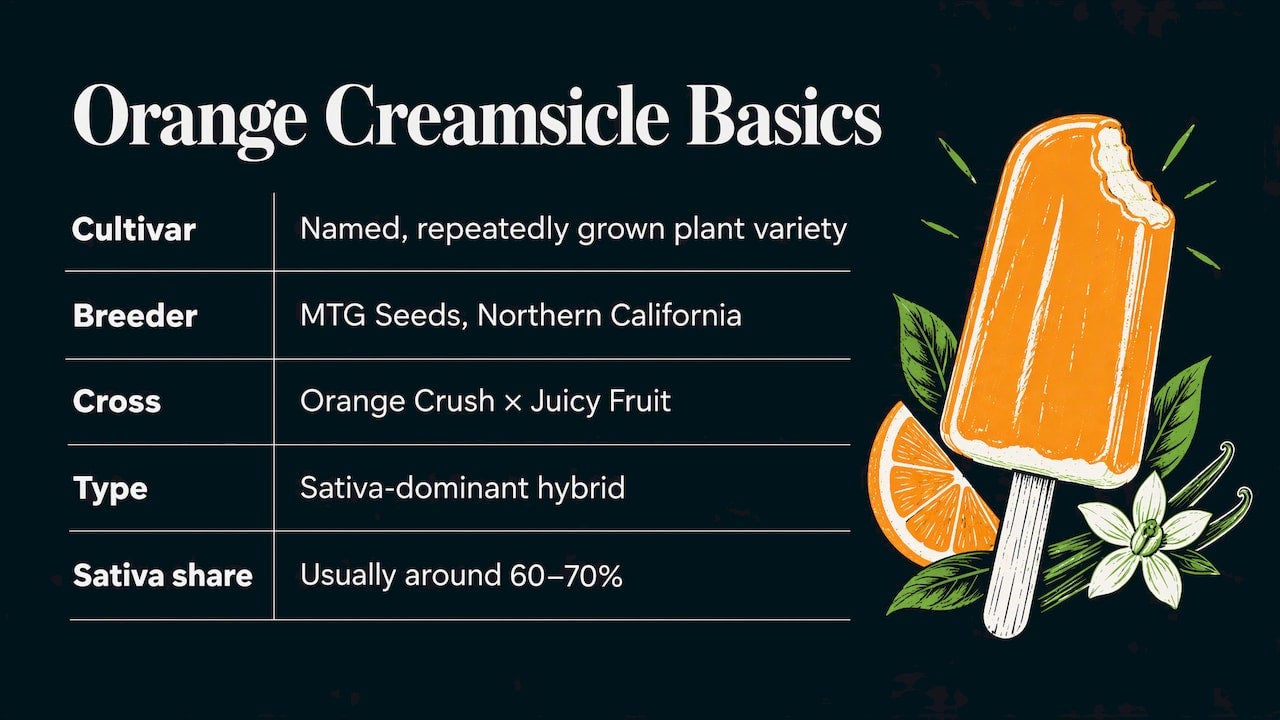
Orange Creamsicle is a hybrid cannabis cultivar named after the orange-and-vanilla ice pop. A cultivar is simply a named, repeatedly grown variety of the plant, and “strain” is the everyday word for it. Herb’s strain guide credits MTG Seeds of Northern California with breeding it as a cross of Orange Crush and Juicy Fruit, and describes it as sativa-dominant, usually cited at around 60 to 70 percent sativa.
The parents explain the flavor. Orange Crush is a citrus-forward line, and Juicy Fruit brings a sweet, tropical-candy side. Together they produce the sweet-orange-and-cream profile that made the name stick.
A caution on lineage: strain databases do not always agree about the deeper family tree, and the same name can be sold by different growers from different seed stock. That is normal in cannabis, and it is why the section on reading labels below matters more than any single genetics claim.
Flavor and aroma: why it tastes like a creamsicle
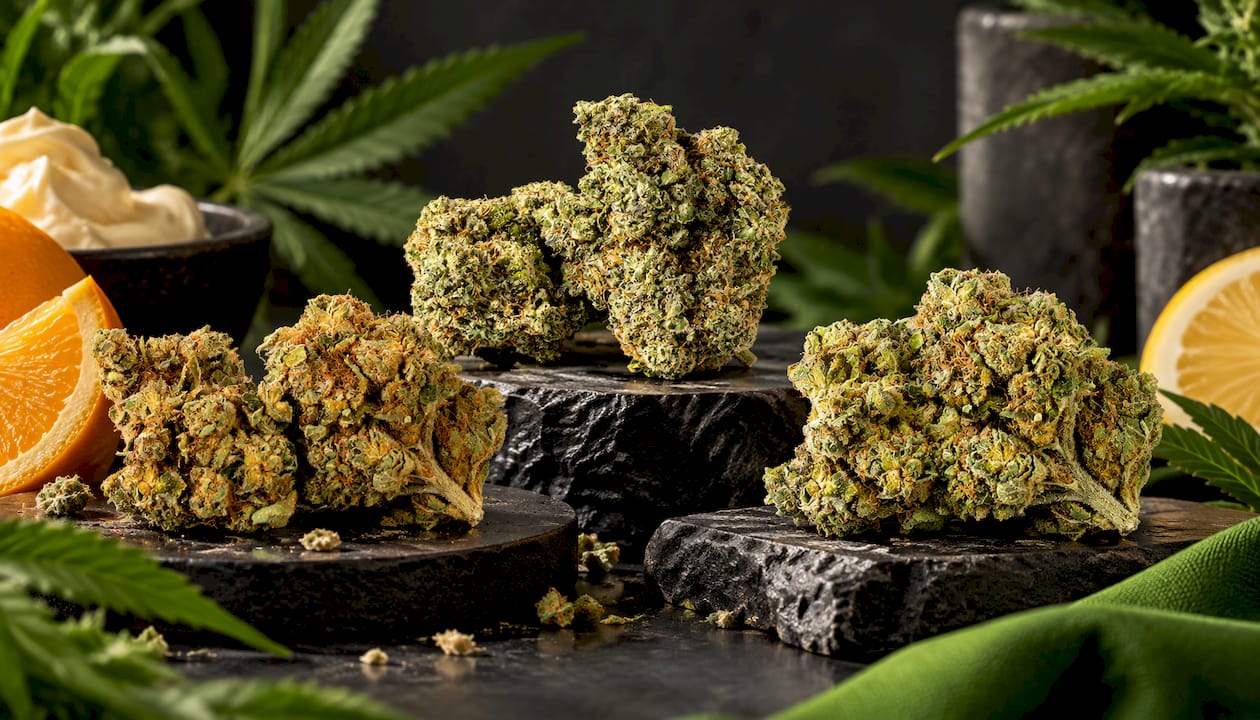
Expect a nose of sweet orange and tangerine, followed by vanilla cream, with some tropical fruit and a faint earthy note on the exhale. One reviewer quoted by Herb compares it to orange flesh rather than orange peel, which is a useful way to picture it: juicy and sweet rather than sharp and zesty.
The same article lists limonene, myrcene and linalool as the dominant terpenes, with caryophyllene and ocimene in support. Terpenes are the aromatic compounds in the plant that shape smell and taste. Here is how the main ones read in practice:
| Terpene | Typical aroma | What it adds to this strain |
|---|---|---|
| Limonene | Citrus, orange peel | The bright tangerine front end |
| Myrcene | Ripe fruit, musk | The soft, fruity body of the flavor |
| Linalool | Floral, lavender | The gentle cream-and-flower finish |
| Caryophyllene | Pepper, spice | A subtle warm bite on the exhale |
If you want to understand how these compounds relate to trichomes (the resin glands on the flower) and to the overall experience, our guide to cannabis terpenes, aroma and trichomes walks through it in plain language.
Terpene percentages shift from batch to batch. A single reported breakdown has caryophyllene leading, while others put limonene on top. Treat the list as a flavor map, not a guarantee.
How strong is Orange Creamsicle?
The published numbers cover a wide band, which tells you something in itself:
- Budvocate’s profile, built on lab data from flower tested in legal US markets between 2014 and 2024, gives a median THC of 19.1 percent.
- Strain Report lists 17 to 24 percent THC and 0.1 to 0.6 percent CBD.
- This Is Why I’m High reports about 23 percent typical THC within a reported range of 15 to 31 percent.
That is a spread of roughly sixteen points. The last source explains why: THC percentage describes the product, not the strain, and it moves with the grower, harvest timing and curing. Two jars with the same name can test several points apart.
CBD is low in every listing, so this is a THC-led strain. If you want to understand how the two compounds differ, see our explainers on THC versus CBD and the CBD to THC ratio.
What a THC percentage means for you
A higher number is not automatically a better experience. If you are new, or if your tolerance is low, a jar at 17 percent and a jar at 26 percent will feel very different, even though the label says the same strain. Choose by the number on the lab result and your own comfort, not by the name.
Effects people report
In Strain Report’s user data, the most common effects are happy (81 percent), relaxed (76 percent), uplifted (66 percent), euphoric (60 percent) and creative (54 percent). Reported side effects are dry mouth (61 percent), dry eyes (33 percent), sleepiness (18 percent), dizziness (11 percent) and anxiousness (9 percent).
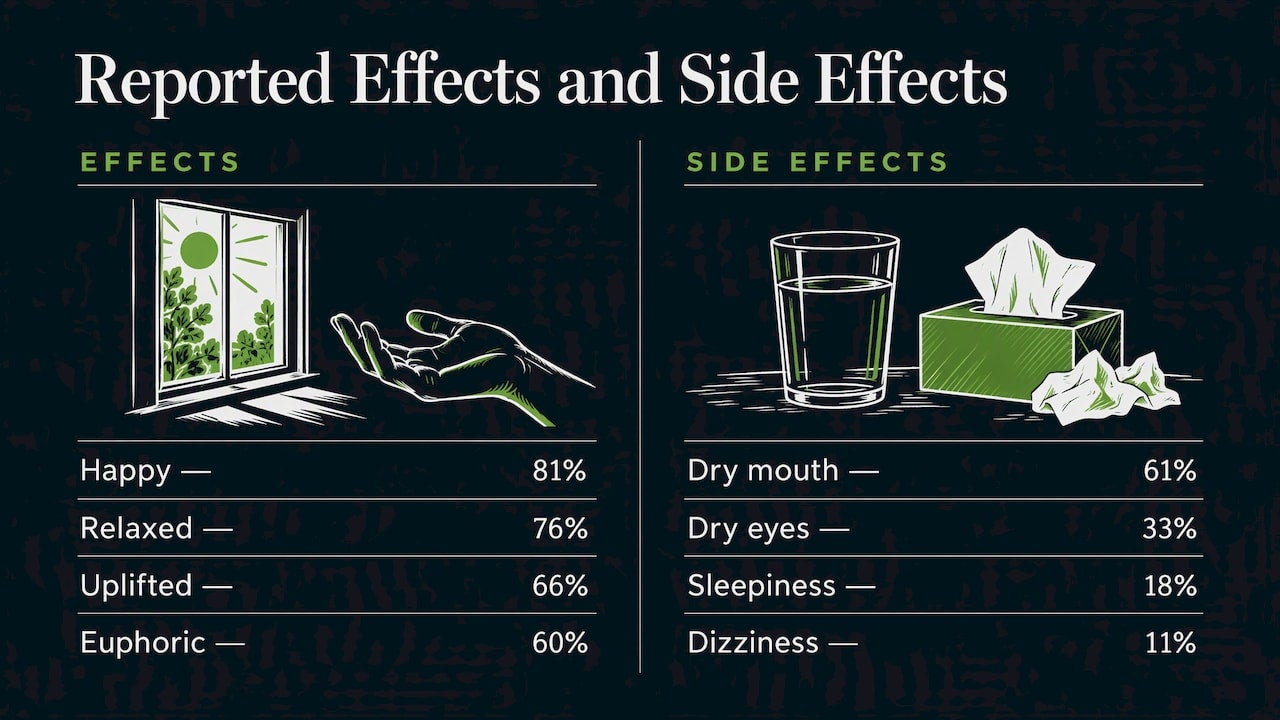
These are self-reports from users, not clinical findings, and individual responses vary with dose, tolerance, setting and the product itself. Still, the pattern is consistent with the sativa-leaning reputation: a bright, mood-lifting start, with a calmer body feel as it settles.
One reviewer at Red Bench Reviews tested a 19.2 percent THC batch in 2020. He described a cerebral head high and body comfort arriving after about 15 minutes, then an easy buzz that lasted several hours. He also noticed that a bong hit noticeably harder than a pipe. Method matters as much as strain.
When people like it
Because of its uplifting reputation, people commonly pick Orange Creamsicle for daytime, social or creative settings: a walk, cooking, music, an afternoon at home. If you tend to feel sleepy or heavy-bodied from cannabis, an orange-forward, sativa-leaning profile is a reasonable thing to look for. If you are sensitive to racing thoughts, keep the dose small.
A new user’s guide to trying it
Cannabis is for adults of legal age only, and the rules depend on where you live and where you buy. Our store ships within Canada, where legal-age purchasing applies. Wherever you are, the approach to a new product is the same.
- Start with a small amount. Health Canada’s guidance on lowering your risks is to start low and go slow, taking a low amount of THC and waiting to feel the effects before taking more. For smoking or vaping it suggests starting with one or two puffs of a product at around 10 percent THC or less. A 23 percent jar is more potent than that, so take the smallest amount you can.
- Wait before you add more. Inhaled effects start within minutes, but give yourself time to judge them. The same Health Canada page notes that eaten or swallowed cannabis can take up to two hours to begin working, and longer to reach its full effect, which is the most common reason people overdo edibles.
- Pick the method that suits your experience. Joints, pipes, bongs and vapes deliver different intensity. The Red Bench reviewer found a bong much stronger than a pipe with the same flower.
- Do it somewhere comfortable. A familiar place, water nearby and no plans to drive are sensible basics. Do not drive or operate machinery after using cannabis.
- Keep a note. Write down the product, batch, amount and how you felt. That one habit tells you more about what works for you than any review.
If you have a heart or lung condition, are pregnant or breastfeeding, take medication, or have a personal or family history of psychosis, talk with your doctor or pharmacist before using cannabis. Keep all cannabis products locked away from children and pets.
How to read a jar: strain name versus batch
A strain name is a starting point. Breeder selection, phenotype (the individual plant’s inherited traits), growing conditions, harvest timing and cure can matter more than the label on the front. Orange Creamsicle shows this clearly. Growers describe two main phenotypes, one tall and stretchy and one short and compact, so two growers can deliver quite different flower under the same name.
When you compare products, look for:
- THC and CBD percentages from a lab test on the specific batch.
- Terpene content, if listed. Limonene-led batches should lean citrus.
- Harvest or packaging date. Fresher flower keeps more aroma.
- Appearance and smell. Orange-toned pistils, dense small nuggets and a sweet citrus scent are what reviewers describe for this strain.
- Grade. Budget, AA, AAA and AAAA tiers usually reflect bud quality, trim and potency. Higher tiers cost more, and the right pick depends on your budget and how much you use.
That last point is where an online catalog helps: with everything sorted by grade and category, you can compare a budget jar with a premium one and decide what the difference is worth to you.
Where the growing information fits
Growers searching this strain will find many cultivation write-ups. Their reported figures vary, for example flowering times of roughly 9 to 10 weeks and a significant vertical stretch. This article is written for people who want to buy and enjoy the flower, so we have not turned it into a grow guide.
Similar flavors if you love orange and cream
If the orange-and-vanilla combination is what you like, there is a whole family of sweet, citrus-and-cream flavors worth exploring:
- Our guide to Orange Push Pop covers another orange-candy profile, with genetics, flavor and buying tips.
- Pink Lemonade leans tart and bright for citrus fans.
- Fruit Loops and Granny Candy are for those who like their flower sweet and cereal-candy fruity.
- Cream Soda is a creamy, sweet profile in our flower range.
And on the shelf right now, Orange Cream (AA) and Lemon Creamsicle (AA) in 28 grams speak directly to the creamsicle idea.
Perspective
Most of the questions we hear about a strain like Orange Creamsicle are really questions about flavor and mood, and the honest answer is that the name only gets you part of the way. The lab result, the grade and the freshness of the batch get you the rest.
That is how we think about our catalog. We source from leading Canadian suppliers and put products through inspections before they reach you, and we organize flower into AAAA, AAA, AA and budget tiers so you can match quality to what you want to spend. Value shoppers and people after something premium both have a place to start.
For newcomers, we like the idea of a gentle first step: a small amount of flower, or a low-dose edible from our edibles range, rather than a big jump. For experienced users who want variety, the range runs from flower and pre-rolls to concentrates, vapes and CBD. Orders over $200 ship free, everything arrives discreetly, and our satisfaction guarantee backs the purchase.
the author
Shop orange-and-cream flavors with us
If the creamsicle profile is what you are after, we carry Orange Cream (AA) and Lemon Creamsicle (AA) in 28 grams, and you can browse everything else in our cannabis flower and pre-rolls. We deliver discreetly across Canada to adults of legal age, with free shipping on orders over $200.
Prefer not to smoke? Our edibles and vapes offer other ways to enjoy fruit-forward flavors, and our CBD range is there if you want something without the high.
FAQ
Is Orange Creamsicle a sativa or an indica?
It is a sativa-dominant hybrid. Herb cites it at around 60 to 70 percent sativa. Some phenotypes lean more relaxing, and your batch may feel different from someone else’s.
Is Orange Creamsicle just orange and vanilla?
Those are the headline notes, but reviewers also describe tropical fruit, a light floral touch and a slightly earthy or spicy exhale. The exact mix depends on the batch and on terpenes like limonene, myrcene, linalool and caryophyllene.
How much THC does it have?
Published figures run from about 15 to 31 percent, with medians nearer 19 to 23 percent depending on the dataset. Use the lab result on your product rather than the strain’s average, because THC shifts with the grower, harvest and cure.
What are the common side effects?
In Strain Report’s user data, dry mouth (61 percent) and dry eyes (33 percent) lead the list, followed by sleepiness, dizziness and anxiousness at lower rates. Start with a small amount and keep water close to keep the experience comfortable.
Sources
- Orange Creamsicle Strain: Everything You Need to Know
- Orange Creamsicle Strain: Lineage and Profile
- Orange Creamsicle Strain: Effects, THC and Reviews
- Orange Creamsicle Strain: Effects and Terpenes
- Smooth Cannabis Orange Creamsicle review
- Health Canada: Lower your risks of cannabis use
Recommended
- Orange Push Pop Strain: Genetics, Flavor, Effects and Buying Tips
- Granny Candy Strain: Genetics, Flavor, Effects and THC
- Pink Lemonade Strain: Genetics, Flavor, Effects and THC
- Fruit Loops Strain: Genetics, Flavor, Effects and THC