

Educational
Blueberry Dream Strain: Genetics, Effects, THC and Flavor

Nov
Blueberry Dream is a sativa-leaning hybrid built on the same Blueberry × Haze pairing as Blue Dream, usually described as sweeter, more berry-forward and a little calmer. Most listings put its THC between the mid-teens and the mid-twenties, and the exact figure depends on the batch. If you want the Dream family in Canada, our Dream Berry and Blue Dream flower listings are the place to start.
TL;DR
- Blueberry Dream is generally described as a sativa-leaning hybrid from Blueberry × Haze, the pairing behind Blue Dream. Records of its exact lineage differ.
- Expect a sweet blueberry nose with herbal haze and pine underneath, and a happy, uplifted, fairly easygoing high.
- Reported THC ranges from about 14% to 26% depending on the source, so the lab report for your batch matters more than the strain name.
- Common unwanted effects are dry mouth, dry eyes and dizziness. Newcomers should start with a very small amount.
- Blue Dream and Blueberry Dream are close relatives, not identical twins. Pick by flavor and mood, not by label.
Table of Contents
- What Blueberry Dream actually is
- Blueberry Dream vs Blue Dream
- Flavor, aroma and appearance
- Effects: what users commonly report
- THC, CBD and how to read a batch
- Unwanted effects and sensible use
- Is Blueberry Dream good for beginners?
- Growing notes for the curious
- Similar strains to try next
- Where to get Dream-family flower in Canada
- Our view on the Dream family
- FAQ
- Sources
What Blueberry Dream actually is
The name causes confusion because two names circulate for what are, in many shops, near-identical jars. Blue Dream is the famous one. It is widely believed to be a cross of Haze and DJ Short’s Blueberry, and High Times reports that breeder Ed Rosenthal confirmed this parentage. The same article notes that people still debate which Blueberry cultivar and which Haze were used.
Blueberry Dream shows up under variations such as Blueberry Dreams, Blueberry Blue Dream and Blue Dream Blueberry. Jolly Green Life attributes the overlap to branding differences, grower phenotypes (the individual expression of a plant’s genes) and infused products that borrow the name. Its summary is that most credible sources trace Blueberry Dream to Blueberry and Haze, and call it a sativa-dominant hybrid.
So is it a separate strain? Think of it as a flavor-led version of the same family. Some records, such as The Herbarium, list it as Blueberry × Haze. Others, such as Ascendancy Strains, say its lineage and alternate names are not recorded. When even the databases disagree, the practical lesson is that the name on the jar tells you less than the lab report and the grower’s description of that particular batch.
Blueberry Dream vs Blue Dream
The two are close enough that many shoppers use them interchangeably. The differences people describe are matters of degree:
| Blue Dream | Blueberry Dream | |
|---|---|---|
| Parentage | Blueberry × Haze | Reported as Blueberry × Haze |
| Type | Sativa-dominant hybrid | Sativa-leaning hybrid |
| Flavor lead | Balanced berry and herbal haze | Sweeter, berry first |
| Mood | Uplifted, balanced | Often described as slightly calmer and smoother |
| Typical THC | 18% to 24% in many listings | Roughly 14% to 26% across listings |
The comparison of mood and flavor follows Jolly Green Life’s description, which calls Blueberry Dream a smoother, more flavor-forward variation of Blue Dream with a berry aroma that outweighs the herbal haze notes. Treat it as a tendency, not a promise: two growers can produce two quite different jars under either name.
If you want the classic balanced Dream experience, look at our Blue Dream (AA+). If you lean toward the sweeter berry side of the family, our Dream Berry (AAA) and Astral Herbs Dream Berry (AAAA) listings are where to look.
Flavor, aroma and appearance
The name is honest about the flavor. Reports describe a ripe blueberry nose with herbal haze and a touch of pine behind it. When the bud is broken up, a more earthy, slightly skunky note can come forward, then the exhale carries sweet berry.
On the plant, descriptions point to vivid green buds with lighter yellow accents, bright orange pistils (the small hairs on the flower) and a thin frosting of amber-toned trichomes (the resin glands that hold cannabinoids and terpenes).
Terpenes behind the berry
Terpenes are the aromatic compounds in cannabis, and they shape both smell and, many users feel, the character of the high. Our guide to cannabis terpenes, aroma and trichomes explains the basics.
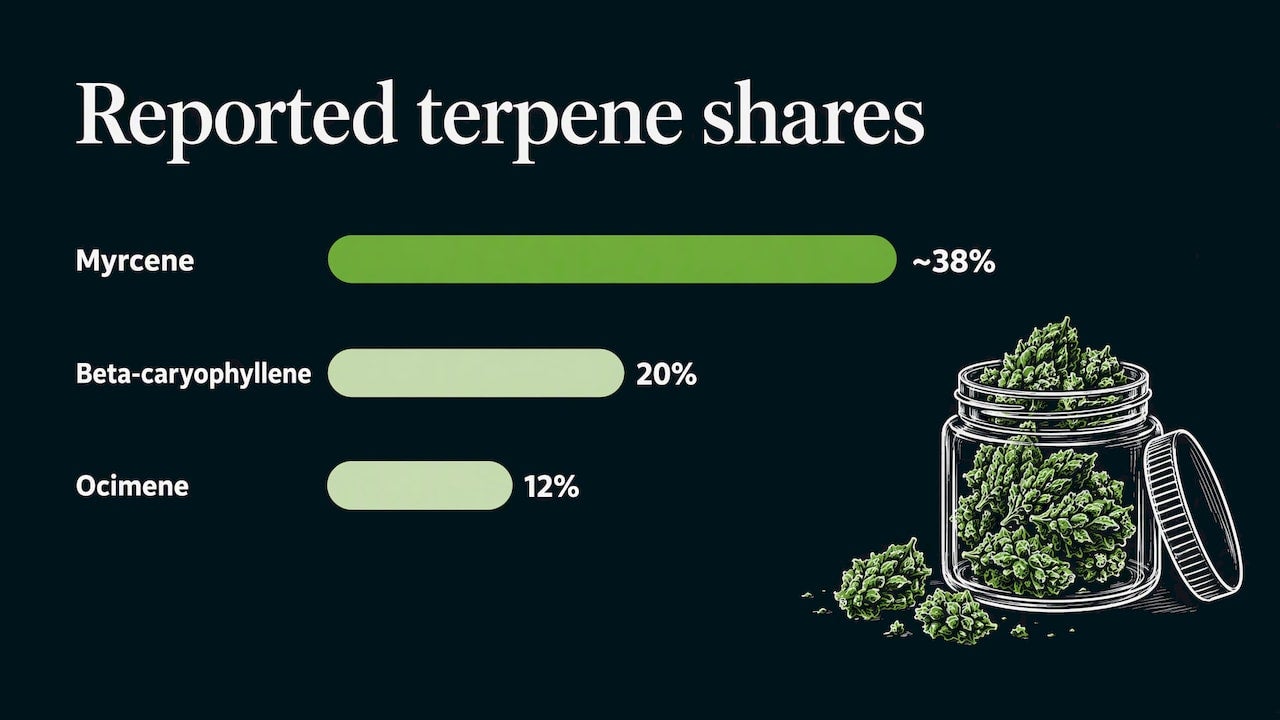
For Blueberry Dream, StrainCompass lists medium levels of caryophyllene and myrcene, with low levels of limonene, humulene, pinene, ocimene and eucalyptol. The Herbarium reports a share of roughly 38% myrcene, 20% beta-caryophyllene and 12% ocimene, and adds that every batch is different. Those numbers are a guide to the usual profile, not a specification for the jar in your cart.
Effects: what users commonly report
Most descriptions line up. The high is usually called happy, light and uplifted, with creative or focused energy early on and a gentle body settle that does not flatten you. WeedDB describes it as a happy, focused feel with a light, upbeat mood that suits the daytime. Ascendancy Strains lists creative, deeply relaxing, focused, happy and uplifted among the positive effects.
That makes it a common pick for:
- A weekend afternoon walk or a creative project
- Social settings where you want to stay chatty
- Cooking, gaming or music
- Anyone who finds heavier indica strains too sedating
Two cautions keep expectations realistic. First, indica and sativa labels are loose shorthand. Research on the topic has found they do not reliably track a plant’s genetics or chemistry, so the label is a hint, not a forecast. Second, effects depend on dose, how you consume and your own body. The same flower can feel brighter in a small amount and heavier in a large one.
If evening relaxation is your priority, our marijuana strains for relaxing selection is organized for that goal.
THC, CBD and how to read a batch
Potency figures for Blueberry Dream vary a lot between databases:
- StrainCompass reports 15% THC and 0.5% CBD as catalog values, and cites one 2017 flower test at 16.7% THC and 0.07% CBD, noting that one test is too few to define a typical range.
- Ascendancy Strains records a THC range of 17% to 26% and CBD of 0.39% to 0.52%.
- The Herbarium lists 21% THC and 0.29% CBD.
- WeedDB gives a typical 14% to 21% THC and CBD under 1%.
The spread, from the low teens to the mid-twenties, is the real answer. Growing conditions, phenotype, harvest timing and curing all move the number. Crushed points out that one record shows 21% THC from a single reading while some shops describe typical batches nearer 14%.
To read a batch well:
- Find the THC percentage on the product page or label and compare it with the strain’s reported range, not with the strain name.
- Note the CBD figure. Even a few tenths of a percent are minor, but a higher CBD share changes how THC feels. Our explainer on the difference between THC and CBD covers it.
- Judge the grade as well as the percentage. Higher THC does not automatically mean better flavor or a smoother smoke.
- Check freshness cues you can see: color, trichome coverage and a distinct berry aroma.
The grade tiers (AAAA, AAA, AA and budget) are how we organize flower at The Chrono, so you can match the Dream family to what you want to spend.
Unwanted effects and sensible use
Blueberry Dream is described as easygoing, but it is still THC-rich flower. Reported negatives include dry mouth, dry eyes, dizziness, feeling sedated and, for some people, anxious or paranoid feelings, which users call “the scaries” (Ascendancy Strains).
A few habits reduce the odds of an uncomfortable session:
- Start small and wait. Crushed recommends newcomers begin with a small amount, especially if the batch tests close to the higher end. With smoked or vaped flower, give it several minutes between puffs. Edibles take far longer to arrive, so do not repeat a dose early.
- Keep water nearby for dry mouth, and eye drops if dry eyes bother you.
- Do not drive or operate machinery after using cannabis.
- Set the setting. A familiar place and a relaxed mood help new users.
- Talk to your doctor first if you take prescription medication, are pregnant or breastfeeding, or have a heart condition or a history of anxiety or psychosis. Cannabis is for adults of legal age only.
Some databases list reasons people use the strain, such as stress, low mood, pain, migraines or attention difficulties. Those lists record what users say, not whether it worked, and cannabis is not a substitute for medical care. Ask your physician about any health condition.
Is Blueberry Dream good for beginners?
Its reputation is friendly: sweet, light on the body and rarely described as heavy. That is a good start. The caveat is potency. A batch in the low twenties can overwhelm someone with no tolerance, and the strain’s gentle reputation can tempt people to take too much.
A beginner-friendly routine looks like this: pick a batch with a clearly stated THC figure, take one or two small puffs, wait fifteen minutes or more, and stop when you feel comfortable. If you would rather skip smoking, edibles and vapes are also available. Our guide to the CBD to THC ratio in cannabis edibles helps you pick a gentler ratio.
Growing notes for the curious
Some readers ask about growing it. Reported figures point to moderate yields: StrainCompass cites about 300 grams per square meter indoors and about 400 grams per outdoor plant. Ascendancy Strains lists a flowering time of 63 to 70 days, average growing difficulty and an outdoor harvest around October. Home-growing rules vary by country and state or province, so check your local law before planting.
Similar strains to try next
If you like the berry-and-haze profile, these are natural next steps from our own guides:
- Pink Lemonade strain for a brighter, citrus-led take
- Fruit Loops strain for candy-sweet fruit notes
For a wider look beyond flower, browse our concentrates, edibles and vapes.
Where to get Dream-family flower in Canada
The Chrono is an online dispensary shipping discreetly across Canada, for adults of legal age. Our flower range spans AAAA, AAA, AA and budget tiers, and we source from Canadian suppliers whose products go through inspection. Orders over $200 ship free, and a satisfaction guarantee backs your purchase.
For the berry-forward side of the Dream family, start with Dream Berry (AAA) or the premium Astral Herbs Dream Berry (AAAA). For the classic, see Blue Dream (AA+).
If you are new to ordering, our full flower and pre-roll category lets you compare grades in one place. Our customer support team is there to help with questions.
Our view on the Dream family
We think the Dream family earns its fame because it makes cannabis approachable. A sweet berry nose, an upbeat mood and a body feel that stays out of the way suit first-time buyers and long-time users alike.
The strain names overlap, and that is exactly why we organize flower by grade and describe each product clearly. A shopper should be able to pick a jar by flavor, budget and potency, not by guessing which name is the real one.
Our approach is built on affordable pricing enabled by scale and supplier partnerships, plus a catalog that covers both value and premium needs. That means someone watching their budget can enjoy the Dream flavor profile, and someone who wants a top-shelf jar can step up a tier.
Start low, go slow, and enjoy the berry.
the author
FAQ
Is Blueberry Dream the same as Blue Dream?
They are close relatives and are often sold interchangeably. Both are linked to a Blueberry × Haze cross. Blueberry Dream is usually described as sweeter and a bit calmer, while Blue Dream tends to be described as more balanced and herbal. Batch and grower matter more than the name.
Is Blueberry Dream indica or sativa?
Most sources call it a sativa-leaning or sativa-dominant hybrid, though a few retailers list it as indica-leaning. Indica and sativa labels are loose guides, so the terpene profile and your own response are better predictors of how it feels.
How strong is Blueberry Dream?
Reported THC runs from roughly 14% to 26%, depending on the source and the batch. Check the lab result for the specific product you buy, and start with a small amount if you are new or the figure is on the high side.
What does Blueberry Dream taste like?
Expect sweet ripe blueberry up front, with herbal haze and pine underneath. Some people notice a faint skunky or earthy note when the flower is broken up, and a sweet berry finish on the exhale.
Sources
- High Times: Cannabeginners, Celebrating Two Decades of Blue Dream
- Jolly Green Life: Blueberry Dream Strain
- The Herbarium: Blueberry Dream
- Ascendancy Strains: Blueberry Dream Strain
- StrainCompass: Blueberry Dream Strain
- WeedDB: Blueberry Dream
- Crushed: Blueberry Dream Strain
Recommended
- Pink Lemonade Strain: Genetics, Flavor, Effects and THC
- Fruit Loops Strain: Genetics, Flavor, Effects and THC
- Unicorn Poop Strain: Lineage, Effects, Flavor and THC
- Electric Kool-Aid: The Strain, the Drink and the Name Explained