

Educational
Acapulco Gold Strain: Origins, Effects, Flavor and How to Choose It

Nov
Acapulco Gold is a legendary Mexican sativa, known for golden-amber buds, a peppery toffee aroma and a bright, cerebral, uplifting high. It is a classic daytime strain, and the best way to enjoy it is to start with a small amount and choose a batch you can read about. If you are in Canada, our Acapulco Gold (AA) flower is ready to order and ships discreetly.
Below you will find where the strain comes from, how it looks, smells and tastes, what people report feeling, what THC range to expect and how to start without overdoing it.
TL;DR
- Acapulco Gold is widely described as a sativa landrace (a wild-adapted, traditional variety) from the Guerrero mountains near Acapulco, Mexico, and it reached American smokers around the mid-1960s.
- Expect golden-amber buds, a peppery, sweet, toffee-like aroma and an energetic, euphoric, focused high that suits daytime.
- Reported THC runs roughly 18% to 25% with almost no CBD, so new users should start with one small puff or 2.5 mg in an edible.
- The name is shared across the market, so the batch details on a product page tell you more than the name alone.
- Dry mouth and dry eyes are the most common side effects; anxiety is also reported, mostly in sensitive people.
Table of Contents
- What Acapulco Gold is and where it comes from
- Appearance, aroma and flavor
- Effects people report
- How strong is Acapulco Gold?
- Why you see so many different “Acapulco Gold” products
- How to start: a careful first session
- Laws depend on where you are
- Our point of view
- Where to get Acapulco Gold in Canada
- If you like Acapulco Gold, try these next
- FAQ
- Sources
What Acapulco Gold is and where it comes from
Acapulco Gold is one of the most famous cannabis names in history. It is commonly described as a sativa landrace from the mountains of Guerrero, east of the Mexican resort city of Acapulco. High Times’ history of the strain notes that most sources call it a pure sativa, while some list versions with indica genetics, so its exact genetic status is still debated.
A landrace is a plant variety that developed over generations in one place, shaped by local soil, climate and farmers rather than by modern breeders. That is why Acapulco Gold has the long, slender, tall growth of a classic sativa and why its character is tied so closely to its homeland. If you want to understand why these old varieties still matter, our piece on why landrace cannabis strains still matter today goes deeper.
The strain’s reputation was built in the 1960s and 1970s, when Mexican weed arrived in the United States in large amounts and Acapulco Gold became shorthand for the best of it. That fame is also the reason the name now appears on many different products.
Is Acapulco Gold a sativa, indica or hybrid?
The short answer: sativa. Most descriptions, including the High Times account above, place it in the sativa family, and its growth habit, aroma and effect profile all fit that label. You will occasionally see it listed as a hybrid, because some modern products carry the name with different parentage.
It is also worth remembering that sativa and indica labels are rough guides rather than precise predictors of how a particular batch will feel. Our guide to how indica and sativa types differ explains what the labels do and do not tell you, and why aroma and the lab-tested terpene profile are often better clues.
Why is it called “gold”?
The name comes from the color. Late in flowering, the buds take on golden-amber to burnt-orange tones. Wikipedia’s entry on the strain records the explanation of Gary Tovar, a well-known figure in the strain’s history, who attributed the distinctive color to how the plants were aged and dried by Pacific Ocean winds. Whether you accept that story or not, the golden look is the visual signature people associate with the name.
Appearance, aroma and flavor
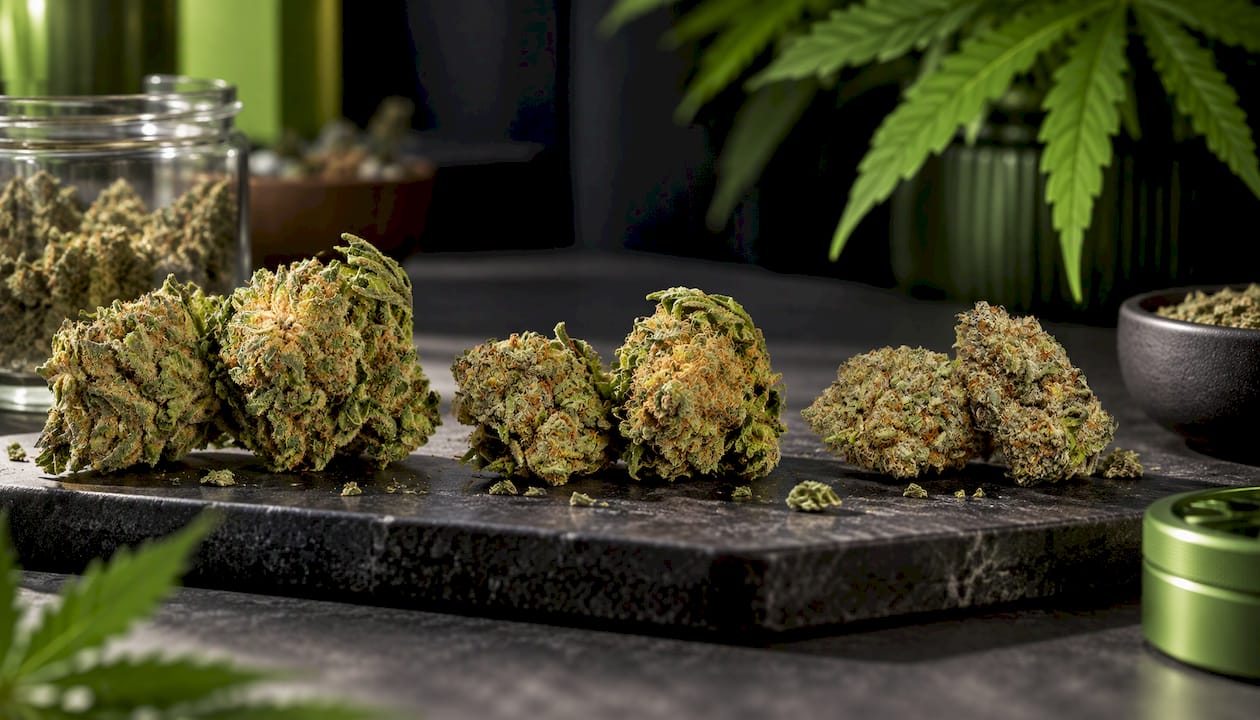
A good Acapulco Gold bud is dense, resin-coated and shows green, gold and amber together. When you break it apart, the aroma is the first thing you notice.
Expect these notes:
- Pepper and spice up front, which points to caryophyllene, a terpene (an aromatic compound in the plant) often listed as the strain’s leading one.
- Sweet toffee or caramel, a warm, honeyed edge underneath.
- Citrus peel, a bright thread usually linked to limonene.
- Earth and pine, the woody finish many people call old-school.
The flavor follows the nose. The inhale tends to be earthy and a little pungent, and the exhale comes back sweet and peppery with a woody finish. It is a dry, spicy profile rather than a sugary dessert one, which is exactly what many long-time smokers love about it.
If terpenes are new to you, our explainer on cannabis terpenes, aroma, trichomes and effects shows how to read a strain’s smell like a menu.
One practical point: aroma depends on growing conditions, harvest timing, curing and age, so two jars sold under the same name will not smell identical. Treat descriptions like the one above as a guide to what to look for rather than a guarantee. The same applies across formats: a vape or concentrate labeled Acapulco Gold may not smell exactly like the flower, because extraction and added terpenes change the picture.
Effects people report
Acapulco Gold’s reputation is energetic and clear. Reviewers describe it as focused, cerebral, uplifting and euphoric, and many reach for it in the morning or afternoon rather than at bedtime. A typical experience, in the words people use:
- A lift in mood within the first few minutes of inhaling.
- Mental focus and a talkative, creative edge.
- A light, comfortable body feel rather than heavy couch-lock.
That said, effects vary from person to person. Differences in how each body’s endocannabinoid system responds mean a strain that feels bright and productive to one person can feel different to another. The practical approach is to find your own comfortable dose, which is why the next sections matter.
Side effects to know about
The Weed Street Journal’s strain guide lists dry mouth and dry eyes as the most common side effects, notes that anxiety is also reported, and says the sativa character can feel racy to sensitive people. Keep water nearby, avoid a big first dose and choose a calm setting for your first session.
How strong is Acapulco Gold?
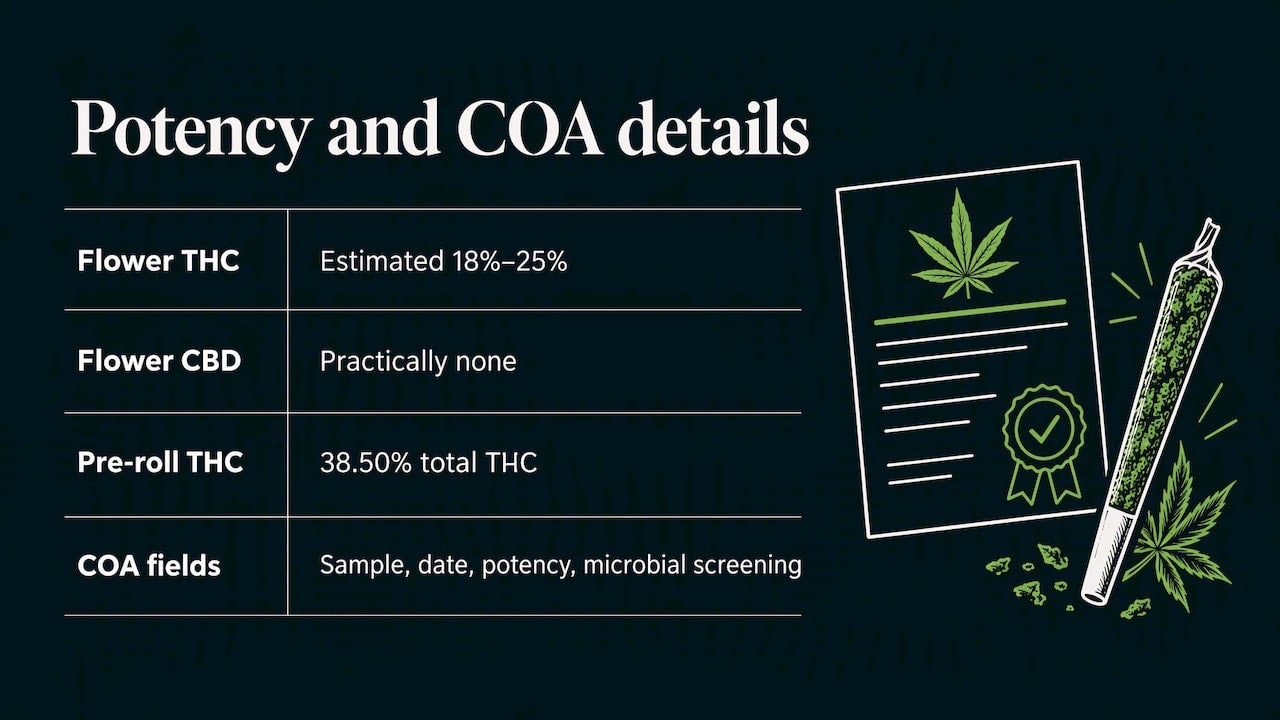
Strain-wide potency numbers are estimates, not promises. Published ranges for Acapulco Gold flower commonly sit around 18% to 25% THC, with practically no CBD, according to Leafwell’s strain page. Some sites list lower or slightly different ranges, which is normal: THC varies by grower, harvest and cure.
The more useful number is the one printed for the batch in front of you. A laboratory certificate of analysis (a COA) is a lab report for one specific batch. For example, a New York lab certificate from November 2025 lists 38.50% total THC for a product labeled Acapulco Gold, but the product is an infused pre-roll, not ordinary flower, so that figure says nothing about the flower. It does show how much detail a batch report carries: the sample, the date, potency and microbial screening.
The lesson for any buyer is the same: compare like with like. A flower percentage, an infused pre-roll percentage and a concentrate percentage are different things, and a name alone does not tell you which one you are looking at.
Some history adds context. A 1975 magazine claim, quoted on the Wikipedia page above, argued that heavy demand and overplanting had already thinned out the original strain’s potency. That is a historical claim, not modern test data, but it fits the picture: Acapulco Gold today is a name with a long past, and modern versions differ.
Why you see so many different “Acapulco Gold” products
The name is so well known that many growers and sellers use it. High Times notes that some products sold under the label may be unrelated hybrids, and that precise lineage is unclear. Plants also adapt to where they grow, so a version grown elsewhere will not always show the same color and aroma as the original Mexican plants.
That is no reason to avoid the strain. It simply means a smart shopper reads the product page the way a wine buyer reads a label.
What to read on a product page
- The grade and format. Flower, pre-roll, vape and edible are not interchangeable. Look at what the listing actually sells.
- THC and CBD percentages for that batch, not just the strain’s general reputation.
- Terpene notes, such as pepper, toffee, citrus and pine, which should line up with the classic profile.
- Appearance in photos: golden-amber tones and visible resin on dense buds.
- Producer information, so you know who grew and packaged it.
At The Chrono, flower is organized by grade, from AAAA down to budget, so you can match the product to your budget and experience. Our description of how we source is simple: premium products from leading Canadian suppliers, backed by rigorous inspections.
How to start: a careful first session
Acapulco Gold sits in the stronger half of the potency range, with little CBD to soften it, so a gentle start is the smart way to enjoy it. Leafwell advises novices to approach it cautiously, to take only a puff or two when inhaling, to wait about 20 minutes before taking more, and to begin with 2.5 to 5 mg for tinctures or edibles. The Weed Street Journal’s guide gives similar advice: one small inhalation or 2.5 mg in an edible, then wait.
A simple routine:
- Pick your moment. Morning or afternoon, at home, with nothing demanding ahead.
- Take one small inhalation, then wait at least 20 minutes before deciding on more. Edibles take longer, so wait longer still.
- Hydrate and keep a snack nearby.
- Stay put. Never drive or operate machinery while impaired, and do not mix with alcohol.
- Keep notes. Write down the batch, the amount and how you felt, so next time you can repeat what worked.
Cannabis is for adults only, and keep it away from children and pets. If you take prescription medication, have a medical condition or are pregnant or breastfeeding, talk to your doctor before using cannabis.
Laws depend on where you are
Cannabis rules differ by country, state and province. The Chrono serves adults of legal age in Canada, with discreet delivery across the country. If you live elsewhere, including in a U.S. state, check your local rules before buying or carrying cannabis, since federal and state law in the United States differ. Age limits also vary: 21 is the common threshold in many U.S. states, while the minimum age in Canada is set by each province or territory.
Our point of view
Acapulco Gold is a strain people love for good reason: it is bright, peppery and sweet, and it has history behind it. We think the best way to enjoy a classic is to know what you are buying and to match it to how you want to feel.
That is why we organize our flower by grade, from AAAA to budget, and why we keep a wide catalog for both first-time buyers and seasoned users. A newcomer can start with a modest amount of a daytime sativa. An experienced user can compare several sativa options side by side.
We source from leading Canadian suppliers, inspect products rigorously and keep pricing affordable through scale and supplier relationships. Orders ship discreetly across Canada, free over $200, and our satisfaction guarantee and responsive support are there if you have a question.
the author
Where to get Acapulco Gold in Canada
If you are an adult shopping in Canada, you can find the strain in more than one form. Our Acapulco Gold (AA) listing is the straightforward place to start, and we also carry MuM’s Cannabis Acapulco Gold and a limited Acapulco Gold promo listing. Free shipping applies to orders over $200, and delivery is discreet.
Want to build a bigger order? Browse the full cannabis flower and pre-roll range, or look at edibles if you prefer a measured milligram dose, and vapes for a quick, tidy format. Mix-and-match bundles let you try several products together.
If you like Acapulco Gold, try these next
Fans of the strain’s classic, uplifting character often explore other profiles with a flavor of their own. Our guides to the Granny Candy strain and the Fruit Loops strain cover genetics, flavor, effects and THC for two very different, sweeter options. And if you ever want to grow, our walkthrough on how to prune cannabis plants properly is a good place to begin, though remember that home-growing rules vary by place.
FAQ
Is Acapulco Gold a sativa or an indica?
It is described as a sativa, specifically a Mexican landrace from the Guerrero mountains. Some modern products using the name are listed as hybrids. Sativa and indica labels are a rough guide, so batch details and aroma tell you more about a given product.
Why is Acapulco Gold considered rare?
The original landrace is tied to one region of Mexico, and the name became so famous that many unrelated products adopted it. Plants also adapt to where they grow, so true copies of the original are hard to reproduce elsewhere. Today the name works more as a shared market label than as proof of one exact lineage.
How strong is Acapulco Gold?
Published ranges for the flower commonly run from about 18% to 25% THC, with almost no CBD. Actual numbers vary by batch, so check the percentage listed for the product you choose. New users should start with one small inhalation or 2.5 mg in an edible and wait before taking more.
What does Acapulco Gold taste and smell like?
Expect pepper and spice, sweet toffee or caramel, a hint of citrus and an earthy, woody, piney finish. The flavor is dry and old-school rather than sugary. Vapes and concentrates with the same name may taste different from the flower.
Is Acapulco Gold good for daytime use?
Most reports describe it as energetic, focused and uplifting, which is why many people choose it for daytime. Sensitive people may find a sativa feels racy, so begin with a small amount in a relaxed setting and never drive after use.
Sources
- Cannabeginners: The History of Acapulco Gold, High Times
- Acapulco Gold, Wikipedia
- Acapulco Gold Marijuana Strain, Leafwell
- Acapulco Gold Strain: Effects, Terpenes and Lineage, The Weed Street Journal
- Certificate of Analysis, New York batch report, 2025
Recommended
- Granny Candy Strain: Genetics, Flavor, Effects and THC
- Orange Push Pop Strain: Genetics, Flavor, Effects and Buying Tips
- Fruit Loops Strain: Genetics, Flavor, Effects and THC
- Unicorn Poop Strain: Lineage, Effects, Flavor and THC